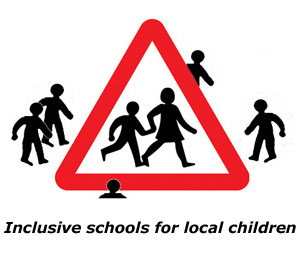
The Council of the London Borough of Richmond are responsible to all the people of the borough for ensuring the best possible schools are provided, given the available funds. There is a growing shortage of good quality secondary school places in the borough. Sites are hard to find and money is tight. But instead of proposing excellent, inclusive schools, the Council is proposing to offer the only site currently available (Clifden Road, Twickenham) to the Catholic Church for a Voluntary Aided Catholic secondary (plus a small primary) - that means a school that will be effectively closed to 90% of the borough who are non-Catholics*. We want to change that.

There are a lot of us: 3367 local people signed our petition asking the Council "to ensure that every state-funded school opening in the borough from now on is inclusive, so that no child can be denied a place in a good local school because of the religion or belief of their parents". That's a huge number for a local petition, especially when we're not backed by any schools, churches or other large organisations. 


Click here to be kept informed about the campaign and to share any comments or ideas. We promise to keep your name and email strictly confidential. You can also join our Facebook group "Richmond Inclusive Schools Campaign". Everyone is welcome, including fair-minded Catholics. The campaign is not anti-religious or party political.


CATHOLIC SCHOOLS CASE GOES TO COURT (press release issued 11 April 2012)

Richmond Inclusive Schools Campaign announced today that the long-running argument about the Council’s plan for an exclusive Voluntary Aided Catholic secondary school is going to court.

In February, RISC pointed out to the Council that, under the new Education Act, a council that thinks it needs a new school must first seek proposals for an Academy/Free School, where there is a limit of 50% faith-based admissions. But the Council is continuing to support proposals for a Voluntary Aided Catholic secondary school so that up to 100% of admissions can be faith-based. The Council’s view is that the Act still enables them to do that. The issue will now be decided in a Judicial Review.

The case is being brought jointly by RISC and the British Humanist Association (BHA). BHA Chief Executive Andrew Copson explained why it had decided to become involved: “We have seen repeatedly how religious providers largely avoid competition when establishing state-funded schools, and instead make arrangements directly with local authorities to open schools without local people being offered any alternative. These approaches to local authorities have always been successful. If the practice is not challenged, we face a future of discriminatory state-funded religious schools being opened without the same rules applying to then as to inclusive schools. In an ideal education system, there would be no state-funded religious discrimination at all, but for as long as it is unfortunately permitted, at least new schools should be opened as a result of fair competition on a level playing field.”

“The BHA respects the fact that RISC is broadly-based and includes many people with religious convictions as well as the non-religious. We also recognise that the main driver for the campaign is not to oppose faith schools generally, but to ensure that new state-funded schools in Richmond do not discriminate against local children on the basis of their parents’ religion, or increase religious segregation. The BHA's own objects include the promotion of equality and non-discrimination, and of understanding between people holding religious and non–religious beliefs. The BHA is taking up this case because of its national implications, but we look forward to working with supporters of RISC, and with Accord, on the basis of this shared understanding.”

RISC spokesman Jeremy Rodell welcomed the BHA’s decision: “We know that the Council and the Catholic Diocese are playing the system to secure the most exclusive type of Catholic secondary school possible. And it has become increasingly clear that the Council has no intention of changing its plans, whatever the outcome of its recent consultation. Only a legal challenge will make any difference, but RISC does not have the resources to mount one. So we very much welcome the BHA’s involvement.”

“RISC remains an inclusive campaign for inclusive schools. There is no change to our position on faith schools generally, which is to focus on whether they are genuinely inclusive. That is why we have not objected to the inclusive primary Free School proposed by the Church of England in Hampton. But the Voluntary Aided secondary school the Council and the Diocese propose is being set up to ensure that 100% of the pupils are children of Catholics, reducing to a minimum of 94% after 7 years. Others need not apply. That can’t be right.”

Rabbi Dr Jonathan Romain MBE, the Chair of the Accord Coalition which formally supports RISC, commented, “We welcome today's news that the Richmond Inclusive Schools Campaign and the BHA are to take legal action on this matter. Accord does not oppose “faith” schools, but has specific aims for legislative reform, including opposing all faith-based admissions. Any moves that will serve to limit religious discrimination must surely gain support from all those who value an inclusive state funded education system.”


Click here to see the reactions of the Council and the Diocese, as well as the press release issued to national media by the British Humanist Association. 


LibDem Councillors come down against using Clifden Road for exclusive Catholic schools

We were pleased to see that the LibDem Councillor group on Richmond Council has formally concluded that the Clifden Road site should not be used for the Catholic schools as they believe it will be needed for community provision. You can see their detailed reasoning and conclusions (issued 18th March 2012) by clicking here.

School provision is too important to be a party-political football, and we hope that open-minded Conservative Councillors will look at the facts and come to similar conclusions.


Why an inclusive school would be better for the borough:

  • Fair admissions: this is the most important point. In inclusive schools, admissions are equally open to all children, regardless of the religion or beliefs of their parents. We think it's simply wrong to set up a new state-funded school that will turn away local children because of the religion or belief of their parents.
    Catholic Voluntary Aided schools set their own admissions policies. All existing Catholic VA schools* they have one thing in common: they always give priority to Catholic families over non-Catholics, even to Catholics living many miles away over non-Catholics living next door to the school. That's in line with the Catholic Diocese of Westminster's view that: "Catholic schools exist to assist parents in handing on the Catholic faith to their children". But around 90% of the residents of Richmond are not Catholics. (We've recently seen a proposal for a "free school" in Chalfont St Peter, Buckinghamshire with a "Catholic ethos" but inclusive admissions, so it can be done - click here for details.)
    *The preliminary proposals from the church are for "up to" 10 of the 30 places at the primary school to be available on a non-denominational basis using distance from the school. Both schools would open in 2013. After 7 years, in 2020, the first cohort of 10 such children - which is likely to include children of Catholics - will be given priority if they want to go to the secondary.  None of the 150 places per year at the secondary school will be directly available on a non-denominational basis, unless there are spare places (which everyone agrees is highly unlikely). So even if all 10 of these children are non-Catholic, and if all decide to go on to the secondary in 2020, children of Catholics will still comprise over 93% of the secondary intake. And for the first 7 years it will be 100%.
     
  • Fair employment: inclusive schools can select and employ the best teachers, regardless of their religion or beliefs, or lifestyle.
    Catholic schools set their own employment policies and are exempt from key equalities legislation. The Catholic Education Service not only asks that Heads, Deputy Heads and Heads of RE should be practising Catholics, but also that schools should favour committed Catholics for other teaching posts. And if you're an excellent teacher who's in a gay relationship, you're unlikely even to seek a position in an institution that considers homosexual activity to be sinful. [In a recent case, a popular headmaster at a Catholic school had to resign because he had divorced and planned to re-marry - see here]


  • Fair curriculum: good inclusive schools teach a fair and balanced syllabus for education about religious and non-religious beliefs. They respect the fact that some parents have sincerely-held religious convictions, and teach children mutual understanding and tolerance as they work together. [And, of course, parents remain free to take their children to places of worship, to send them to religious classes outside school and to run their homes in line with their beliefs.]
    In a Catholic school, the Religious Education syllabus is set by the Church, and RE teaching is inspected by the Church, not by Ofsted.


  • Quality: this is not an issue about quality. There are excellent faith schools and excellent inclusive schools. The two secondary schools in the Borough of Richmond judged "outstanding" by Ofsted are both community schools.


  • Community cohesion: we live in a plural society in which there is considerable religious diversity. Nationally, half the population is not religious. Segregating children by the religion of their parents can do nothing to assist mutual tolerance and understanding across the community.


There's already one state-funded Christian faith school in the borough, where Catholics are favoured over non-Christians in admissions. And there's a Catholic fee-paying school. But there is no "right" for anyone to be provided with taxpayer-funded schooling in order to hand on their particular faith. Most other taxpayers would consider that an unfair privilege, even though it is within the law.


We believe the great majority of people in the local community want any new taxpayer-funded schools in the borough to be excellent inclusive schools and do not want a new Catholic Voluntary Aided school.

info@richmondinclusiveschools.org.uk


Set up and backed by local people. Supported by The Accord Coalition http://accordcoalition.org.uk whose members and supporters include Ekklesia (the Christian think tank), the General Assembly of Unitarian and Free Christian Churches, a number of prominent Anglican churchmen and women, the Runnymede Trust, British Muslims for Secular Democracy, the Hindu Academy, the British Humanist Association  and many others. The Chair of Accord is Rabbi Jonathan Romain.

Left Image
SocialTwist Tell-a-Friend